



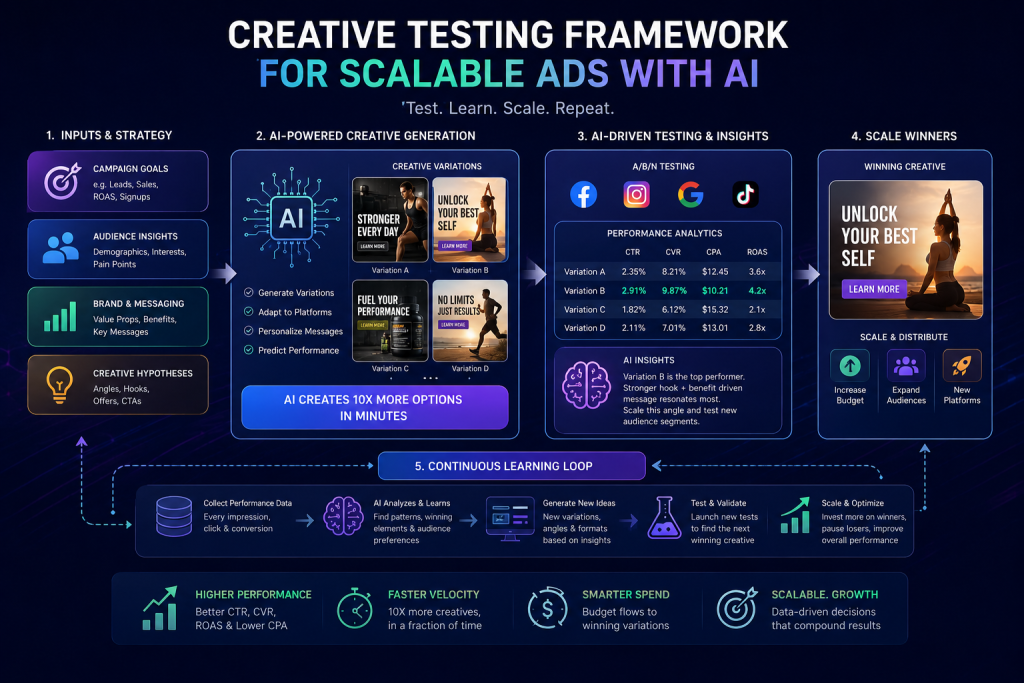
A Creative Testing Framework for Scalable Ads Powered by AI
Unlocking predictable growth in a crowded digital landscape requires more than great creative. It demands a repeatable, data-driven framework that turns experimentation into scalable wins. For digital marketing companies and agencies alike, the path to scalable ads begins with a vision: use AI to shorten feedback loops, validate hypotheses faster, and continuously optimize performance across every channel.
A structured experimentation mindset
At the heart of scalable advertising lies a disciplined approach to testing. Start by articulating a small, testable hypothesis for each creative concept, audience segment, and placement. For example, a hypothesis might be: “A concise, benefit-focused headline paired with a high-contrast visual will improve click-through rate by 15% among mid-funnel audiences.” With AI, you can automate the generation of variants, streamlining ideation without sacrificing quality. The key is to design tests that isolate one variable at a time so results are clean, actionable, and interpretable by humans and models alike.
Segment-aware creative design
Audiences respond differently to color, tone, and messaging. A robust framework accounts for segments such as newcomers, returning visitors, and high-intent users. By mapping each segment to a tailored creative approach, AI can craft multiple asset variations that align with intent and stage in the funnel. This requires a modular asset library: headlines, hero images, value propositions, social proof, and calls to action that can be recombined automatically while preserving brand standards. The result is a scalable catalog of creative options ready for rapid deployment and testing at scale.
AI-assisted ideation and production
Advances in AI, including models like GPT-5-Nano, empower agencies to generate copy variants, image prompts, and video scripts that resonate with target segments. A well-architected system uses AI to draft dozens of variants, then forwards the most promising options to human reviewers for policy alignment, brand fit, and nuanced quality checks. This human-in-the-loop approach preserves trust and compliance while accelerating throughput. Automation tools can also optimize asset sizing, aspect ratios, and format adaptation for different platforms, ensuring consistency without manual rework.
Testing at the speed of platforms
Different ad platforms demand different creative formats and pacing. A scalable framework treats each platform as a distinct testing battleground while preserving a unified measurement approach. Rapid A/B tests across social, search, display, and video help identify which formats drive the strongest signals for your objectives—brand lift, consideration, or conversions. Leverage AI to automatically allocate budget toward winning variants, while maintaining guardrails to prevent overfitting to a single platform or audience.
Quality assurance as a competitive advantage
In high-stakes advertising, a slick concept without quality can backfire. A rigorous QA process guards against misalignment with brand guidelines, regulatory requirements, and platform policies. AI can perform preflight checks for adherence to copyright, safety policies, and ad specs, flagging issues before they impact performance. Regular audits of attribution models, pixel implementations, and audience segment definitions ensure data integrity, a cornerstone of reliable experimentation.
A data-centric experimentation playbook
A scalable approach requires a clearly defined measurement framework. Establish primary metrics aligned with business goals—such as cost per acquisition, return on ad spend, or customer lifetime value. Use secondary metrics to diagnose path issues: engagement rate, time-to-conversion, and cross-channel interaction. Employ multi-touch attribution or data-driven attribution to understand how different touchpoints contribute to outcomes. With AI, you can automatically normalize for seasonality, creative fatigue, and external events, isolating genuine effects from noise.
Creative fatigue management through AI
Creativity thrives on novelty, but fatigue erodes performance. A forward-looking framework incorporates fatigue signals—such as diminishing CTRs, rising frequency, or audience saturation—and triggers fresh creative variants automatically. AI can schedule rotations, refresh asset libraries, and reallocate budgets to newer, higher-performing combinations, all while preserving learnings from prior tests. This balance between freshness and stability keeps campaigns resilient over time.
Cross-channel consistency and storytelling
Customers rarely move linearly from one channel to another. A scalable framework ensures a cohesive narrative across touchpoints. AI can harmonize tone, value propositions, and calls to action so that a user who encounters a video ad on a social feed encounters a consistent message when they click through to search results or a landing page. This seamless cross-channel storytelling enhances brand recognition, reduces cognitive load, and improves attribution accuracy by maintaining coherent signals across environments.
Ethical and compliant testing practices
Trust is essential in digital marketing. A robust testing framework includes guardrails for privacy, consent, and data security. Ensure compliant data collection, minimization, and storage practices, especially when audience insights intersect with sensitive attributes. Transparent reporting, clear user consent mechanisms, and responsible AI usage guidelines help protect brands and customers alike, maintaining long-term sustainable growth.
GPT-5-Nano and the future of creative automation
Emerging AI models like GPT-5-Nano offer capabilities that can accelerate ideation, copywriting, and even creative concept validation. When integrated thoughtfully, these tools augment human judgment rather than replace it. Use AI to draft variations, generate hypothesis-driven briefs, and simulate performance under different budget scenarios. Always couple AI outputs with human review focused on brand alignment, emotional resonance, and ethical considerations. The combination of AI speed and human rigor yields scalable, high-quality ads that stand up to scrutiny and deliver measurable impact.
Operationalizing the framework
To translate this framework into a repeatable engine, build a pipeline that connects ideation, production, testing, deployment, and analysis. Define roles and responsibilities: creative leads, data scientists, media buyers, and compliance officers collaborate within a shared workflow. Establish version control for creative assets, test configurations, and reporting dashboards so learnings are traceable and reusable. Schedule regular review cadences to interpret results, retire underperforming variants, and scale winning formulas.
Measurement and learning loops
Effective scaling relies on closed-loop learning. Capture every experiment’s outcome, including context, hypotheses, and environmental conditions. Use Bayesian or frequentist methods to determine when to stop tests and confidently scale. Report insights not just as numbers but as narratives that reveal why certain creative treatments resonated with audiences. Translate these learnings into playbooks that guide future campaigns, shortening cycles and increasing the odds of repeatable success.
A culture of continuous improvement
Beyond tools and dashboards, successful scalable advertising hinges on culture. Encourage experimentation as a core value, with leadership investing in training, knowledge sharing, and cross-functional collaboration. Foster psychological safety so teams feel comfortable proposing bold ideas and acknowledging failures as learning opportunities. When people see a direct link between tested ideas and business outcomes, momentum builds and performance compounds over time.
Bringing it all together for digital market agencies
For digital marketing agencies seeking scalable ads, the integration of AI-powered creativity with rigorous testing disciplines creates a defensible competitive edge. A well-executed framework delivers faster time-to-insights, higher relevance for diverse audiences, and more efficient use of budgets. It also supports stronger client trust through transparent reporting, ethical AI usage, and demonstrable impact. By combining modular asset libraries, AI-assisted production, platform-aware deployment, and robust measurement, agencies can transform experimentation into a scalable engine of growth.
In practice, start with a pilot that tests a handful of segment-specific concepts across two platforms. Use AI to generate a portfolio of variants, implement a clear hypothesis, and measure outcomes with rigorous attribution. Learn from the results, document the decision rules, and scale the winning configurations across campaigns and clients. With this approach, creative testing becomes a strategic asset—one that delivers consistent performance, strengthens brand fidelity, and drives meaningful business outcomes in a dynamic digital market landscape.